

Mercor is usually described as an AI recruiting company, an AI hiring marketplace, or sometimes a competitor to Upwork.
I think all three descriptions miss what makes the company interesting.
Mercor did not become successful because it built a better job board. It did not win because its profiles were prettier, its search was better, or because an AI interviewer magically solved recruiting.
Mercor succeeded because it discovered something much more powerful:
a single, enormous service that requires hundreds of different kinds of human expertise.
That service is helping train, evaluate, and improve AI.
Once I started looking at Mercor through that lens, its business made much more sense.
And it also made the ugliness of traditional marketplaces like Upwork much easier to see.
The ugliness of the traditional marketplace
Think about what Upwork actually does.
A company arrives and says:
build me a Shopify store;
fix this Python script;
design my kitchen;
prepare a financial model;
translate this document;
create a logo;
configure my AWS infrastructure;
edit this video;
write marketing copy.
These jobs have almost nothing in common.
The scope is different.
The duration is different.
The way quality is measured is different.
The workflow is different.
The required communication is different.
The deliverable is different.
The pricing model is different.
As a result, Upwork cannot really provide the service itself. It provides the human hooks around the service.
Post a job.
Search.
Filter.
Send proposals.
Look at profiles.
Chat.
Interview.
Negotiate.
Hire.
Track hours.
Send messages.
Leave reviews.
Dispute a payment.
These are all human coordination mechanisms.
And they’re ugly.
Not because Upwork is badly designed. Quite the opposite: Upwork has spent years making this machinery as efficient as possible.
The problem is structural.
If you operate a marketplace containing thousands of fundamentally different types of work, the platform cannot understand and manage every transaction deeply enough to eliminate the humans from the coordination loop.
So it connects the two sides and gets out of the way.
The client still has to figure out whom to hire.
The freelancer still has to sell himself.
Both sides still have to communicate.
Both sides still have to negotiate.
Both sides still have to manage the ambiguity.
Upwork digitized the labor market, but the underlying interaction is still remarkably similar to hiring someone before the internet existed.
A marketplace profile is just a better classified ad.
A proposal is a digital cover letter.
The messaging system is a digital meeting room.
The rating is a digital reference.
The core transaction remains deeply human.
Mercor looks like a marketplace, but behaves like a service company
Mercor is different.
On its expert-facing website, Mercor says it connects professionals to AI-training projects and works with leading AI companies to train and evaluate advanced models using human expertise. Experts review model outputs, create examples, evaluate quality, and provide domain-specific judgment.
Look at the range of people Mercor recruits.
Software engineers.
Doctors.
Lawyers.
Accountants.
Investment bankers.
Consultants.
Finance professionals.
Scientists.
Educators.
Cybersecurity specialists.
At first glance, that looks like the same horizontal expansion as Upwork.
It isn’t.
The crucial difference is that Mercor is not adding hundreds of unrelated categories of work.
It is adding hundreds of categories of expertise to roughly the same underlying type of work.
A lawyer isn’t coming to Mercor because a random company needs a contract drafted.
A programmer isn’t primarily coming because some startup needs a React application.
An accountant isn’t coming because a small business needs its books reconciled.
They are increasingly being recruited for variations of one fundamental job:
Use your professional expertise to make an AI system better.
Mercor describes software-engineering opportunities, for example, as work that helps train frontier AI systems using real software-engineering judgment. Its business-professional offering similarly connects finance, marketing, HR, and other specialists with AI labs training models on corporate work.
That changes everything.
Mercor effectively has one vacancy with hundreds of specializations
This is the mental model I find most useful.
Mercor doesn’t really have hundreds of completely different job categories.
It has something closer to:
AI trainer / evaluator — software engineering
AI trainer / evaluator — medicine
AI trainer / evaluator — law
AI trainer / evaluator — accounting
AI trainer / evaluator — finance
AI trainer / evaluator — education
AI trainer / evaluator — cybersecurity
That’s an incredible business architecture. The domain changes. The expert changes. The subject matter changes.
But much of the operational system remains the same.
Mercor can repeatedly:
source → assess → qualify → onboard → assign → evaluate → pay → retain
And then run the same machine across hundreds of professions.
That’s dramatically different from Upwork.
Upwork cannot create one standardized workflow for:
designing a logo + migrating a database + filing taxes + creating an architectural rendering.
Those are different services.
Mercor can create a much more unified workflow because the service it sells is much narrower.
Human expertise applied to AI training and evaluation.
This gives Mercor something traditional labor marketplaces almost never have:
laser focus without a small market.
Normally, focus means narrowing your TAM.
Mercor found a way to remain extremely focused while continuously increasing its addressable supply.
It doesn’t need to add new types of transactions.
It can simply add more types of experts.
Mercor doesn’t necessarily need to expose the marketplace
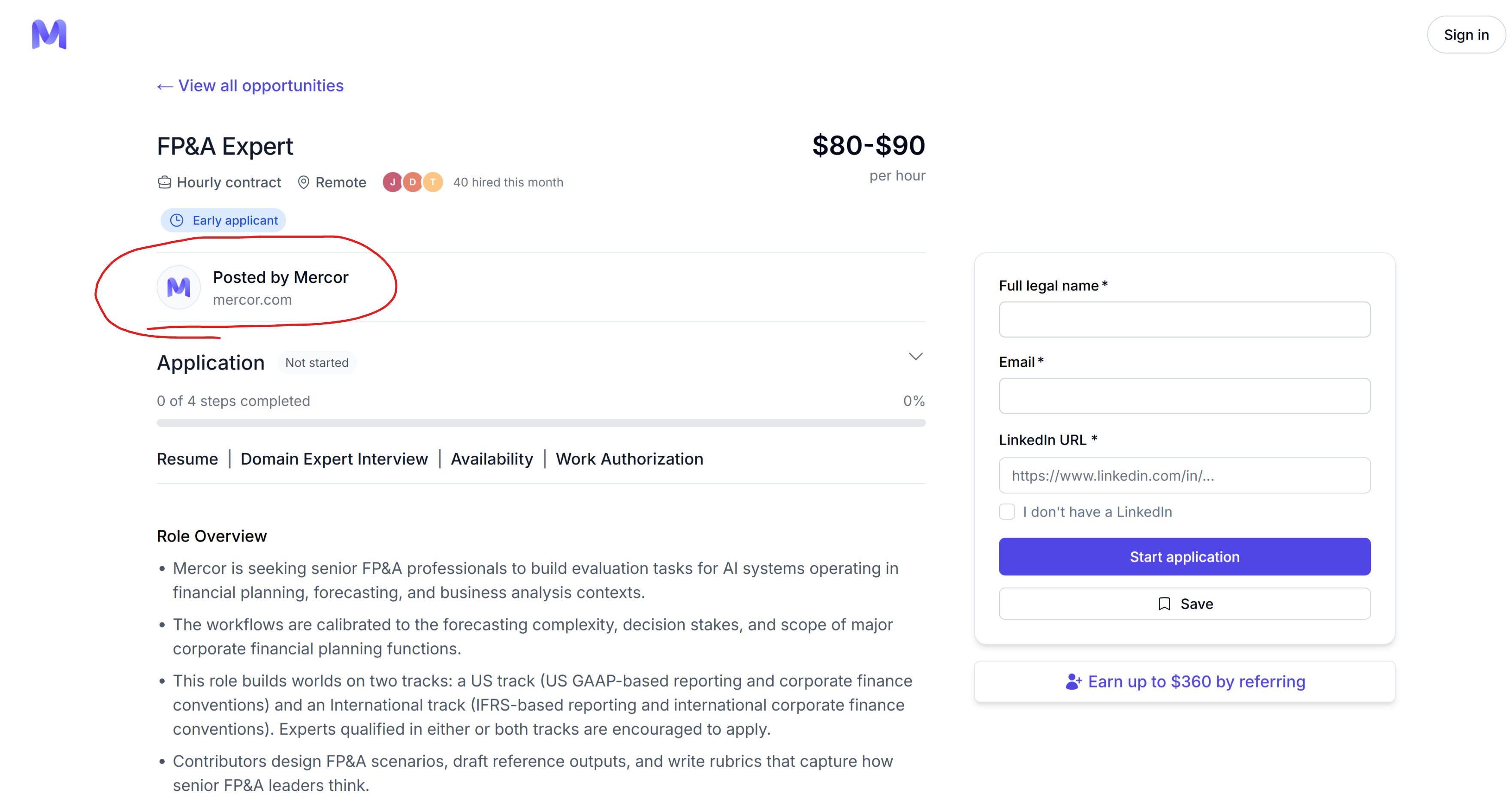
Another unusual characteristic makes the model even stronger.
Many Mercor listings don’t prominently tell the worker which underlying AI company ultimately needs the work.
Instead, the listing may say that Mercor is hiring experts to support projects with “leading AI labs” or research organizations. Mercor’s current listings also explicitly state that workers are engaged as independent contractors and paid weekly.
That means the experience can look like this:
AI company → Mercor → expert
rather than:
AI company ↔ expert, with Mercor sitting between them
That sounds like a small distinction.
It isn’t.
It fundamentally changes what kind of company Mercor can become.
Traditional marketplaces expose both sides.
You know who the freelancer is.
The freelancer knows who the client is.
The freelancer often knows what the client pays.
The client knows what the freelancer receives.
The platform then charges some visible fee for facilitating the relationship.
That creates constant pressure to bypass the platform.
Why should the client keep paying the intermediary once they’ve found a great freelancer?
Why shouldn’t the freelancer contact the company directly?
Why shouldn’t they take the relationship off-platform?
Marketplaces spend enormous effort creating rules, escrow systems, reputation incentives, messaging restrictions, contracts, and other mechanisms to prevent this leakage.
These are more human hooks.
Mercor can avoid some of that problem because Mercor itself can effectively own the service relationship.
The customer isn’t necessarily buying John Smith. The customer is buying something closer to:
Give us qualified software engineers who can produce this type of evaluation data at this level of quality and at this scale.
Mercor then figures out which humans should produce it.
The worker isn’t necessarily selling himself to OpenAI, Anthropic, Google, or whoever sits behind a particular project. He is selling his expertise to Mercor.
Mercor turns that expertise into a service for its customer.
That’s much closer to a managed service company than a traditional labor marketplace.
The marketplace is internal
This is probably the most important distinction.
Mercor absolutely has marketplace dynamics.
It needs demand.
It needs supply.
It needs matching.
It needs liquidity.
It needs reputation.
But much of that marketplace can exist inside Mercor rather than in front of the customer.
That’s powerful.
Imagine an AI lab needs:
300 software engineers,
100 accountants,
60 lawyers,
40 doctors.
A traditional marketplace might turn that into 500 different hiring relationships.
Mercor can turn it into a capacity problem.
How many qualified people do we have?
How quickly can we evaluate more?
Which people have performed well before?
Which expertise is scarce?
Which workers should receive which tasks?
Which outputs need additional review?
Which people should remain on the project?
That’s not really a job board anymore.
It’s a human-intelligence supply chain.
Now the AI interviewer makes much more sense
Mercor became famous partly because of its AI interview and automated candidate assessment.
If Mercor were merely another job board, I wouldn’t consider this particularly revolutionary.
There have been attempts to automate recruiting for decades.
But automated interviewing becomes extremely valuable when the company itself needs to qualify enormous quantities of labor.
Mercor’s expert product explicitly says that its AI interview is designed to evaluate expertise at scale and adapts questions to a person’s professional background.
That’s the key phrase:
at scale.
Suppose an AI lab suddenly needs 1,000 technically capable people.
The traditional approach requires recruiters, screening calls, interviews, scheduling, evaluation, and coordination.
Mercor can turn assessment into infrastructure. Now the AI interviewer isn’t the product. It’s one machine inside the factory.
And that is a far more compelling use of AI.
Work generates the next advantage: performance data
Once Mercor controls the workflow, another thing happens. It stops knowing people only through resumes.
Initially Mercor might know:
This person studied physics at MIT.
Then:
This person performed well in our assessment.
Then:
This person completed 400 hours of real work.
Eventually:
This person consistently produces high-quality outputs on a particular category of task, needs little correction, works quickly, and has been retained by multiple projects.
That is radically more useful information.
The company can move from credential-based hiring toward observed-performance-based allocation.
And that creates a flywheel:
better assessment → better placement → more work → more performance data → better assessment → better placement
Traditional job sites rarely get this.
LinkedIn knows what I claim I’ve done.
Upwork knows somewhat more because it can see transaction history and reviews.
Mercor can potentially see the actual performance of workers inside a relatively standardized system.
That allows reputation to become less subjective.
Mercor can also hide its economics
There’s another consequence of the managed-service structure.
A transparent marketplace tends to make the economics obvious.
The freelancer charges $100 > The client pays $110 > The platform makes $10.
Everyone understands exactly where the margin sits.
Mercor doesn’t necessarily have to work like this.
Mercor can tell an expert:
We will pay you $100/hour.
Separately, it can tell an AI company:
Here is the price for the service we provide.
Those don’t have to be the same economic object.
And that is important.
Mercor isn’t necessarily charging a marketplace commission.
It can price outputs, capacity, quality, speed, expertise, and reliability.
The expert’s compensation becomes Mercor’s cost of production. The customer price becomes whatever the service is worth.
I haven’t seen evidence that lets me confidently claim customers never know what individual experts are paid. Contract structures will certainly vary.
But structurally, Mercor doesn’t need contractor compensation to define the customer’s price.
That’s the important part.
And the numbers suggest just how significant this structure has become.
The Information reported that Mercor exceeded a $2 billion gross annualized revenue run rate in June 2026, while roughly 60–70% of top-line revenue was being paid out to contractors. That would imply hundreds of millions of dollars of annualized net revenue remaining after contractor payouts.
That’s not the economics of a cute recruiting app.
That’s the economics of a massive labor operation wrapped in software.
Why now?
None of this would have mattered without an extraordinary demand event.
Frontier AI companies suddenly discovered that training increasingly capable models required huge quantities of sophisticated human judgment.
Not simply cheap labeling.
Expert judgment.
A model needs to understand medicine? Get doctors.
Finance? Get bankers and analysts.
Software engineering?Get experienced engineers.
Legal reasoning? Get lawyers.
Business? Get operators and consultants.
Mercor happened to build a machine for sourcing and assessing humans just as some of the richest and fastest-growing companies in history developed an enormous appetite for exactly that resource.
As of 2026, that concentration remains remarkable. The Information reported that roughly 91% of Mercor’s first-half gross revenue came from foundation-model makers, including customers such as OpenAI, Anthropic, and Google DeepMind.
This is why I think explanations of Mercor that focus primarily on “AI recruiting” miss the point.
The technology mattered. But the demand shock mattered more.
Customers didn’t need to be convinced that they should experiment with a new recruiting interface. They needed massive quantities of qualified human intelligence.
Immediately.
Mercor found a rare form of vertical integration
The best description I can come up with is that Mercor vertically integrated a new labor market.
Instead of merely saying:
Here are some people. Good luck hiring them.
Mercor increasingly handles:
finding them,
assessing them,
matching them,
contracting them,
paying them,
routing work,
evaluating performance,
and building a historical understanding of who is good at what.
That’s what allows the customer-facing product to become dramatically simpler.
The ultimate interface could almost be:
I need 500 qualified experts.
And Mercor responds:
Done.
The complexity still exists. It just moved inside the company. This is what great platforms sometimes do.They don’t eliminate complexity. They absorb it.
That’s why calling Mercor a marketplace undersells it
Mercor started with recruiting.
It still has marketplace characteristics.
And from the outside, the worker experience still looks like applying for jobs.
But economically, I think the more useful mental model is:
Mercor is a software-defined service company that acquires human expertise as an input and sells organized human intelligence to AI companies.
That explains almost everything.
It explains why it can conceal the identity of the ultimate buyer in many engagements.
It explains why automated interviewing matters.
It explains why it can expand into hundreds of professions without becoming unfocused.
It explains why it can manage the transaction itself.
It explains why contractor performance data becomes valuable.
It explains why it can potentially price independently on both sides.
And it explains why Mercor looks so different from Upwork despite superficially connecting companies with workers.
Upwork sells access to humans.
Mercor increasingly sells the result of organizing humans.
That’s a much better business.
The irony
The internet was supposed to transform labor marketplaces.
In many cases, it mostly gave us better ways for humans to find other humans.
Profiles.
Search boxes.
Messages.
Reviews.
Applications.
Scheduling.
Interviews.
Those things are useful.
But they’re still hooks connecting people together so that the people can manually complete the actual process.
AI gives us the possibility of something different.
The platform doesn’t necessarily have to help the buyer find the supplier.
It can understand the work deeply enough to become the supplier interface itself.
That’s what I find fascinating about Mercor.
Its breakthrough wasn’t putting AI into recruiting.
Its breakthrough was finding a service where AI could help Mercor internalize enough of the marketplace that the marketplace itself started disappearing.
Behind the scenes there are tens of thousands of humans.
In front of the customer there can increasingly be one company: Mercor.
And that, much more than an AI interviewer or a better hiring website, is why I think Mercor actually succeeded.