

Mister Blocks is the youngest company we have covered here by a wide margin. Its first commit landed on the evening of November 7, 2026. Four days and 108 commits later it has had 767 visitors and 3,418 page views, a post in r/ClaudeCode that passed 21,400 views, and a Product Hunt launch running today.
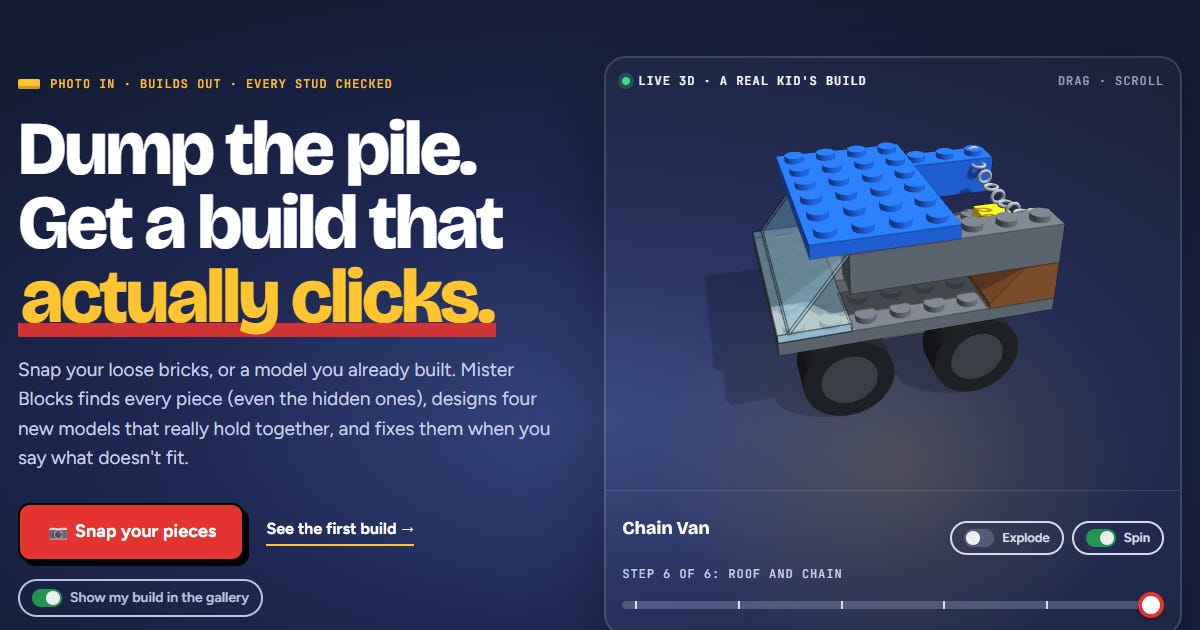
The pitch fits in one sentence: take a photo of the loose LEGO bricks on your table, and get a few models you can build from exactly those pieces, with step-by-step 3D instructions. No pile at hand? Describe something in words (a robot dog, a stadium, SpongeBob’s house) and get a model for that instead.
Disclosure: Mister Blocks is my own project. The numbers below are taken straight from its analytics, Reddit and Product Hunt dashboards on launch day.
Early traction: what the numbers say
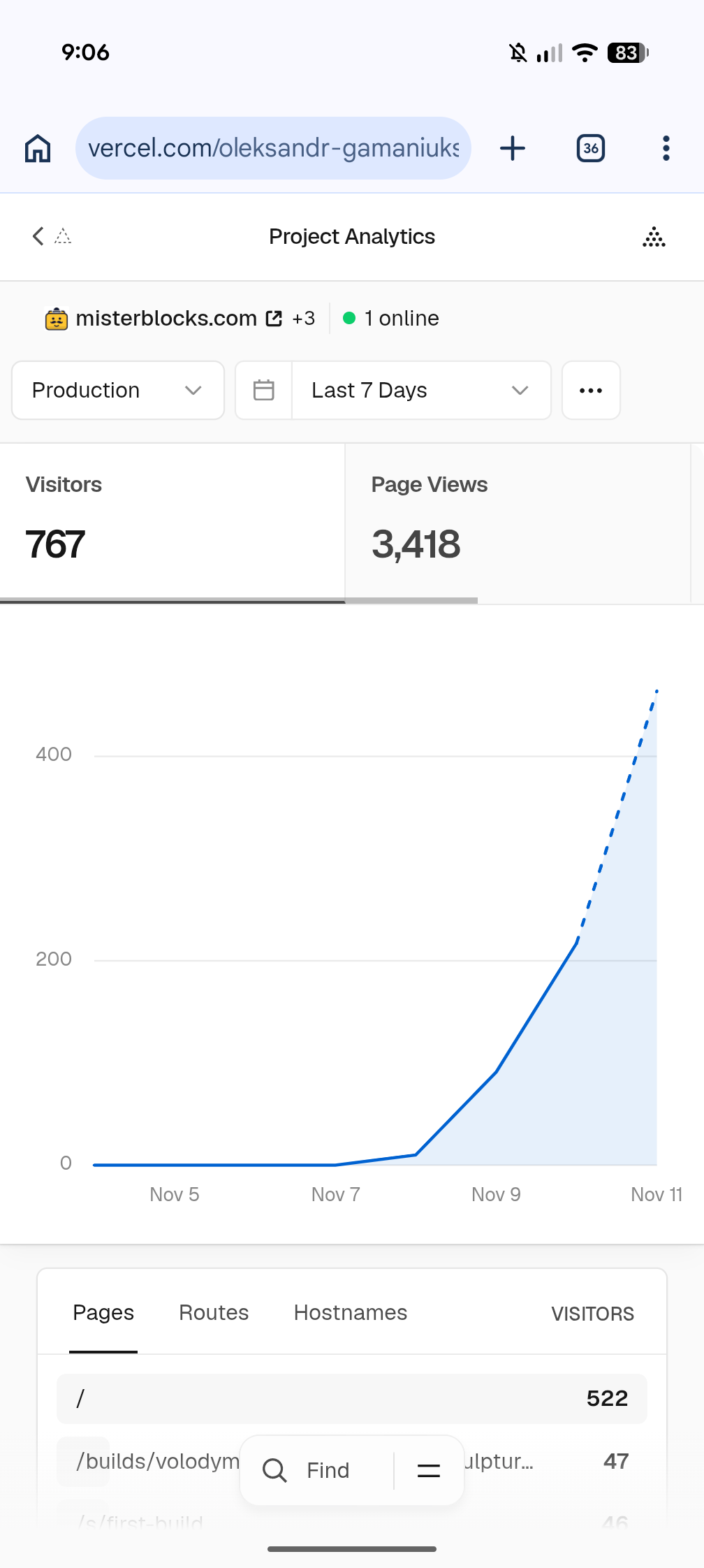
Visitors. Vercel Web Analytics shows 767 visitors and 3,418 page views over the last seven days, almost all of it from November 9 onward. The curve roughly doubled each day: around 90 visitors on November 9, about 220 on November 10, and close to 460 on November 11 with the day still running.
Depth. 3,418 page views over 767 visitors is about 4.5 pages per visitor. For a site whose main content is a 3D viewer, that means people were opening several guides, not just the home page. The home page had 522 visitors; the most visited build guide (a voxel sculpture) had 47, and the featured first build 46.
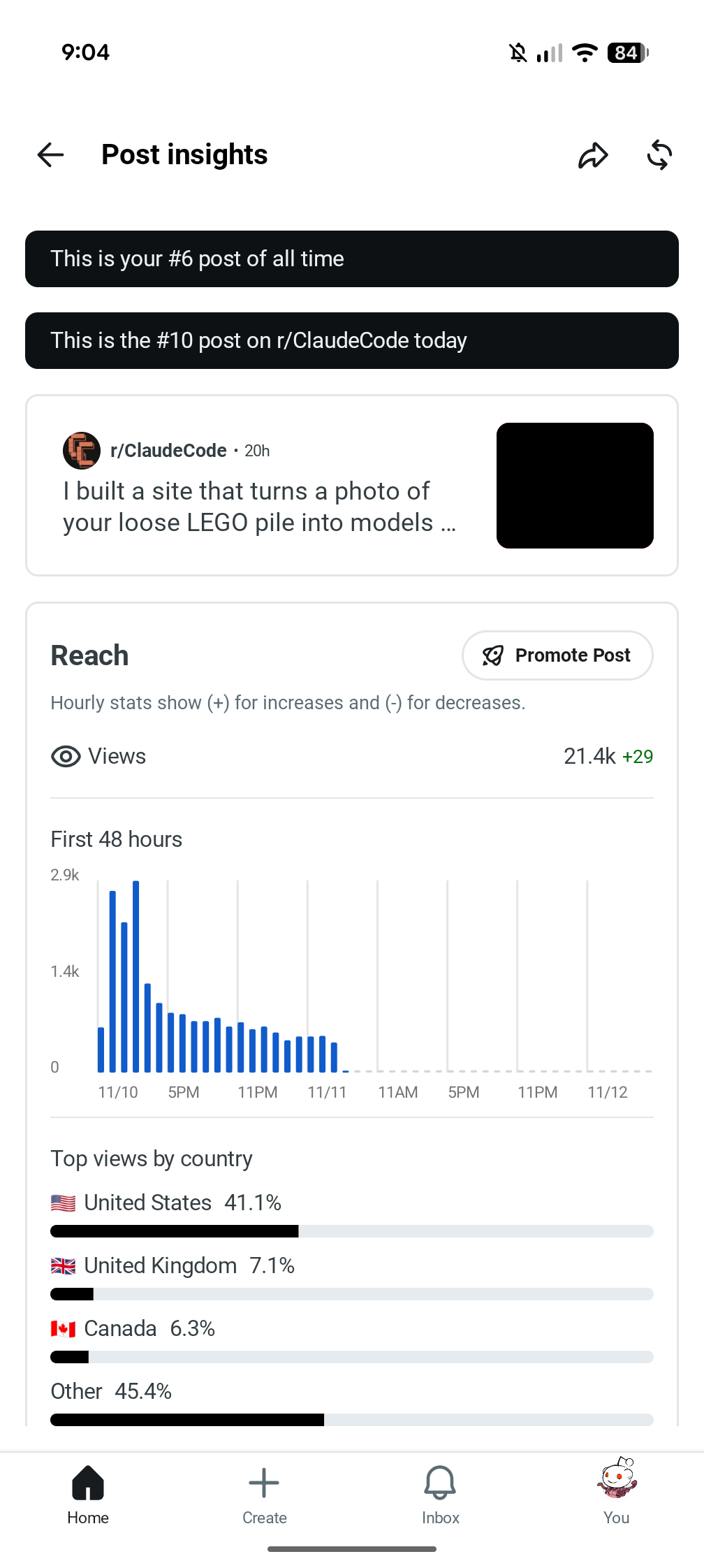
Reddit. A single post in r/ClaudeCode, “I built a site that turns a photo of your loose LEGO pile into models…”, reached 21,400 views in its first 20 hours, peaked at roughly 2,800 views an hour, and was the #10 post in the subreddit that day, with 54 upvotes and 31 comments when last checked. 41% of its views came from the United States, 7% from the UK and 6% from Canada.
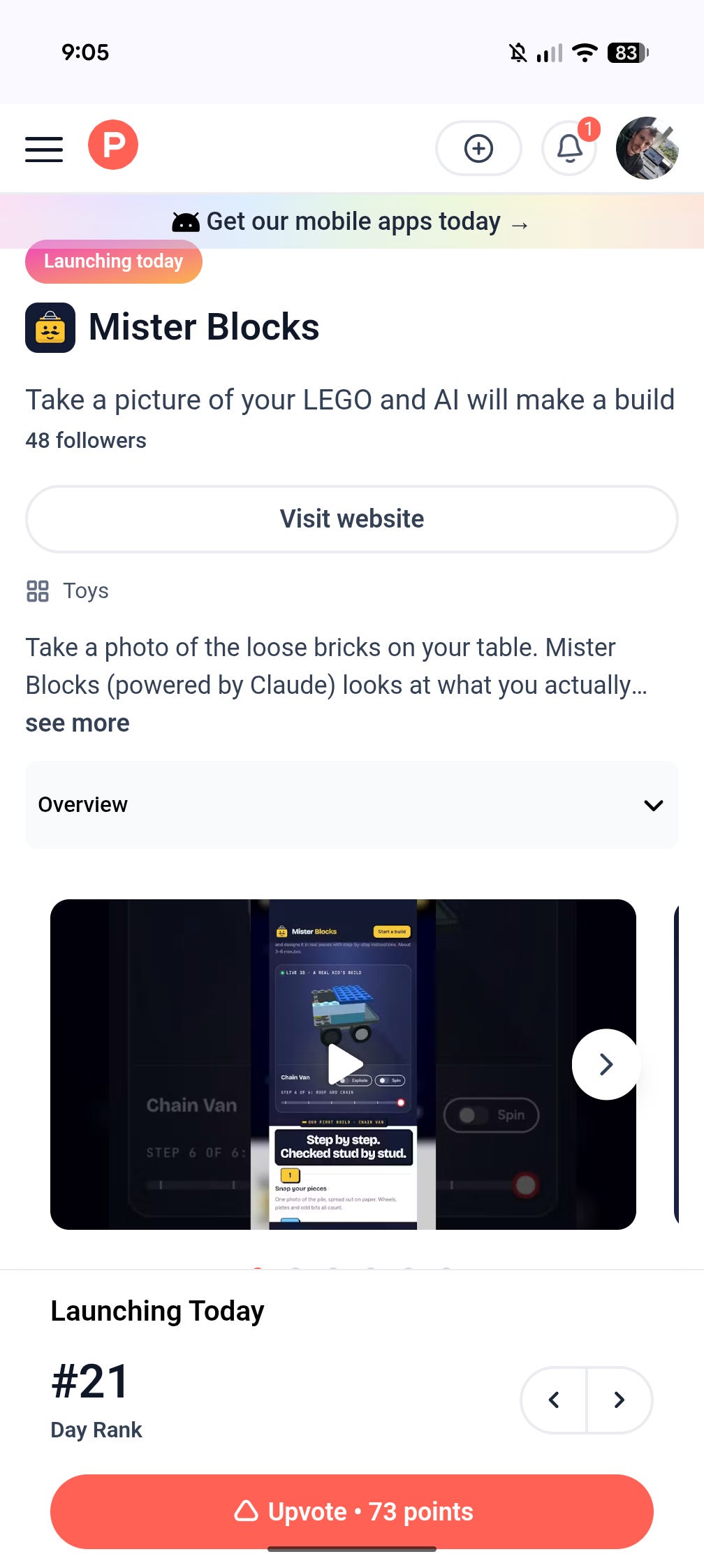
Product Hunt. Launched today in the Toys category, Mister Blocks was sitting at #21 for the day with 73 points and 48 followers at the time of writing.
What the product actually does
There are two ways in.
From a photo. Claude Opus 5.5 reads the photo into a list of pieces (sizes in studs, colours), then designs a few models from that list. You can correct the count in a chat (“there are 48 of the 2×4s”) and ask for changes (“make it a tow truck”).
From an idea. Type what you want. The pipeline researches it (up to three web searches), plans a size and piece count, designs it, checks the shape against the plan, looks at its own ASCII drawings of the model, and fixes every stud before saving. It takes a few minutes.
Every model goes through a stud checker before anyone sees it: each piece must sit on studs, nothing may overlap, wheels must turn, and the instructions must be buildable in order. Problems go back to the model in plain English until it passes. That loop, not the prompt, is what makes the builds hold together in real plastic.
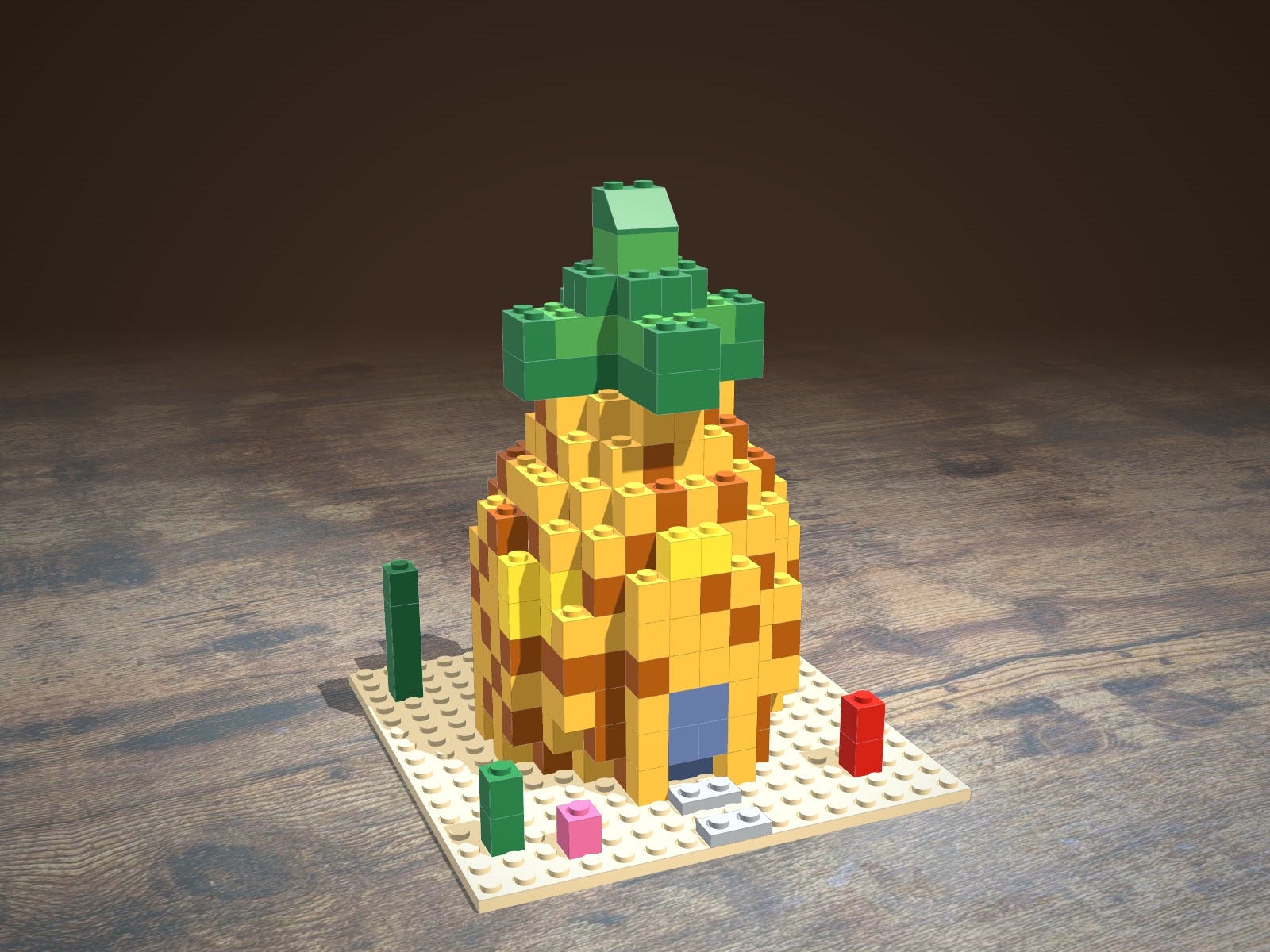
SpongeBob’s Pineapple House: 237 pieces, one of the free guides.
The catalog: content as a growth engine
Alongside the photo tool, the site ships more than a hundred free building guides in 16 categories, from cars and robots to anime, video games and 1,300-piece voxel sculptures. Each one is a server-rendered page with a title written in the words people search (“LEGO FNAF MOC”, not the character’s full name), a picture for Google Images, structured data, and a printable booklet and PDF.
That is the long-term bet: the photo tool brings people in on launch day, and a growing library of guides brings them in from search the rest of the year. The whole site also exists in Ukrainian at /uk.
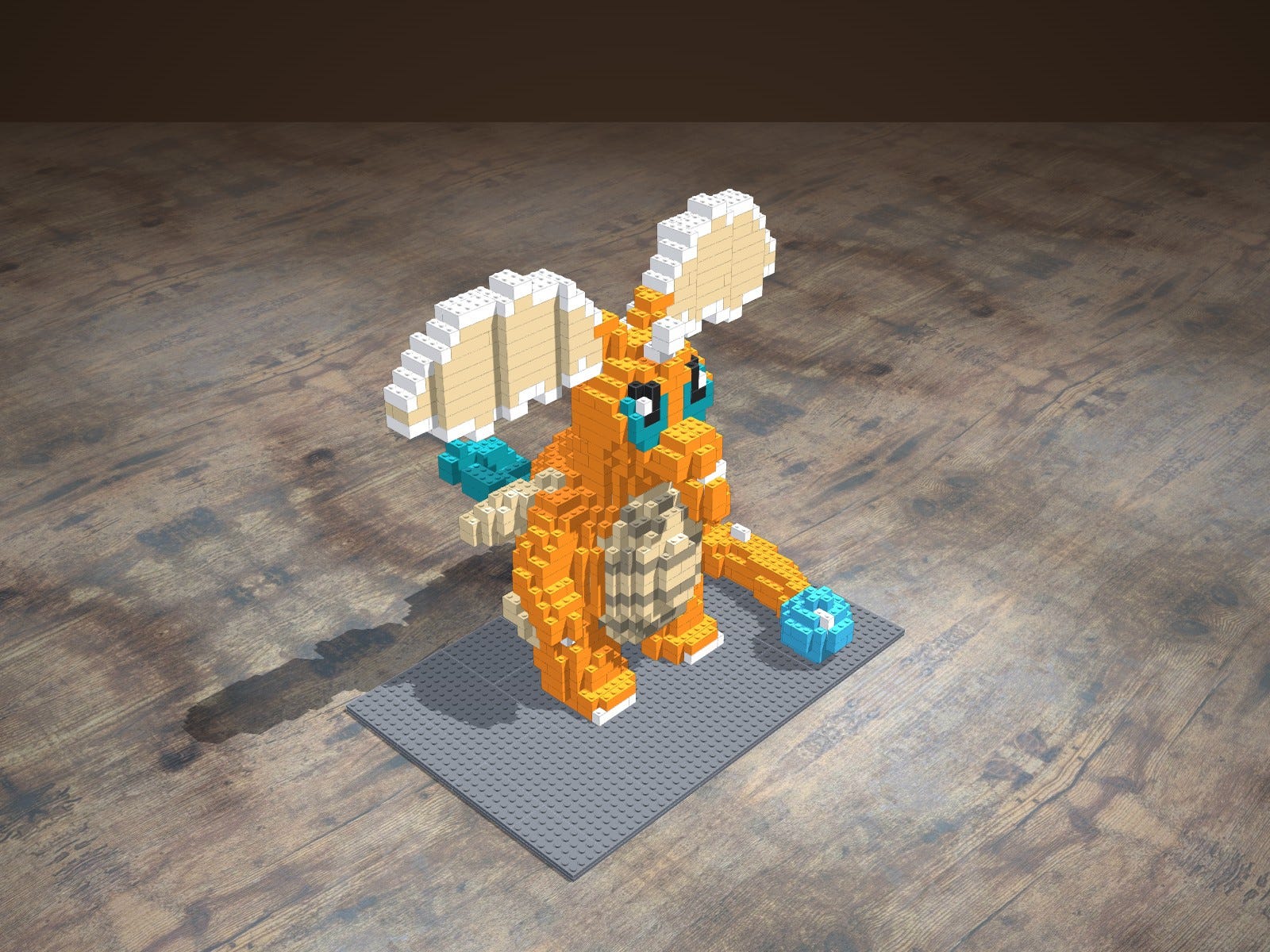
Mega Dragonite, a voxel sculpture of about 1,300 pieces.
What it costs to run
Each new build is a few minutes of Claude Opus and costs a couple of dollars in API calls. Every call is logged in dollars, the site has a daily budget ($25 by default), and each visitor gets 5 photo builds, 4 idea builds and 40 chat messages a day. The guides, booklets and PDFs cost nothing per visit, because the models are stored and the pictures are drawn in the visitor’s browser.
The stack is deliberately small: plain Node functions on Vercel, Cloudflare in front for the domain and R2 for images and PDFs, MongoDB, and three.js for the viewer. No framework.
Where it is strong
A real, specific problem every family with a tub of mixed LEGO has.
Builds that are checked stud by stud, not just pictures of bricks.
A free content library that compounds through search, in two languages.
Speed: idea to public launch in four days.
Where it is limited
Recognising small pieces in a messy photo is still the hardest step; a photo of bricks spread out on white paper works best.
Every new build costs real money, so free use is capped per day.
It is an unofficial fan project: no official LEGO sets or instructions, and no affiliation with the LEGO Group.
Why Mister Blocks is one to watch
Four days in, the signals are the ones that matter for a consumer AI tool: a launch post that travelled on its own, visitors who stay for four or five pages, and a library that should keep pulling search traffic long after launch week. The next test is whether parents come back on a rainy weekend without a Reddit post to remind them.
You can upvote it on Product Hunt today, browse the free guides, or tip a few handfuls of bricks onto white paper and try it at misterblocks.com.
LEGO® is a trademark of the LEGO Group, which does not sponsor or endorse Mister Blocks. Characters and brands belong to their owners.