

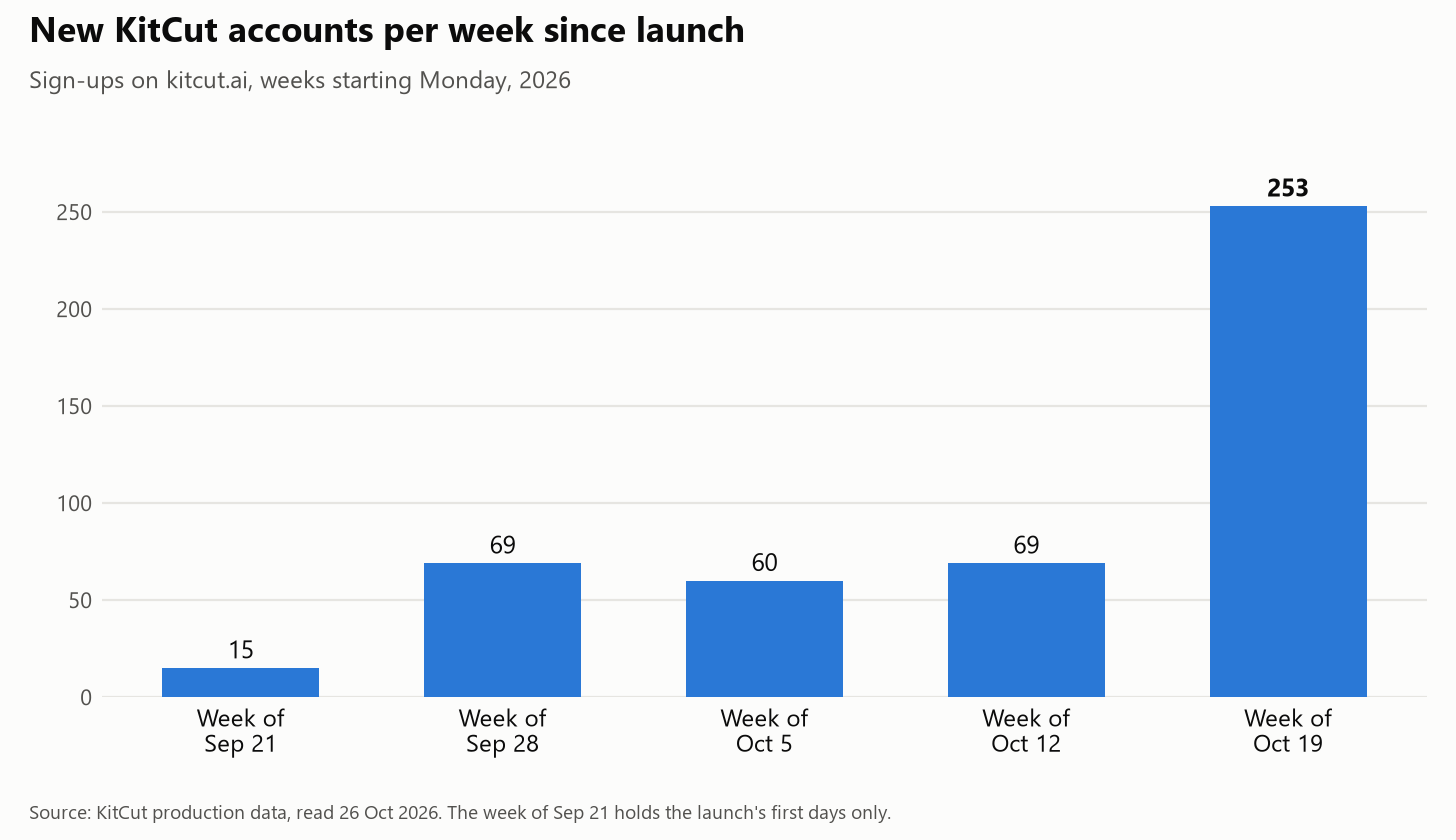
KitCut is one of the youngest companies we have covered here, and one of the fastest-moving. The AI film maker opened to the public at the end of September 2026. A month later it has close to 500 accounts, more than 800 finished films, and a public library on its homepage of over 300 films that people chose to share. Sign-ups in its fifth week were more than three times those of any week before.
The pitch is simple: type an idea, and get back a finished, narrated, scored animated film, from 5 seconds to 8 minutes long. What makes KitCut different from the wave of AI video generators is how the film is made, and that difference is also why it can sell finished video for less than most of them charge for raw clips.
Early traction: what the numbers say
KitCut launched in the last days of September. Here is where it stood on 26 October 2026:
~500 accounts in its first month, with 253 new ones in the week of October 19 alone, up from 60 to 69 a week through early October.
825 finished films: 213 in September, and 612 in October so far, almost three times as many.
About 12.5 hours of finished film made in October so far, up from about 3 hours in September.
305 public films in the library on the kitcut.ai homepage: explainers, news bulletins, lessons, cartoons, invitations and product videos that their makers chose to show the world.
That public library is the best evidence of why people come back. Nobody is asked to share a film; a film is link-only unless its maker makes it public. Hundreds of people did, which is what you see from people who are proud of what they made.
Two things keep coming up in what users say and do: they love what the technology lets them make (a real explainer with the right words on screen, a recurring character, a whole series), and they love the price.
The price: finished films for less than raw AI clips
In October KitCut published a pricing comparison at kitcut.ai/compare, setting its own price beside the cheapest published 1080p price of 11 AI video services, each read from the vendor's own pricing page on 25 October 2026.
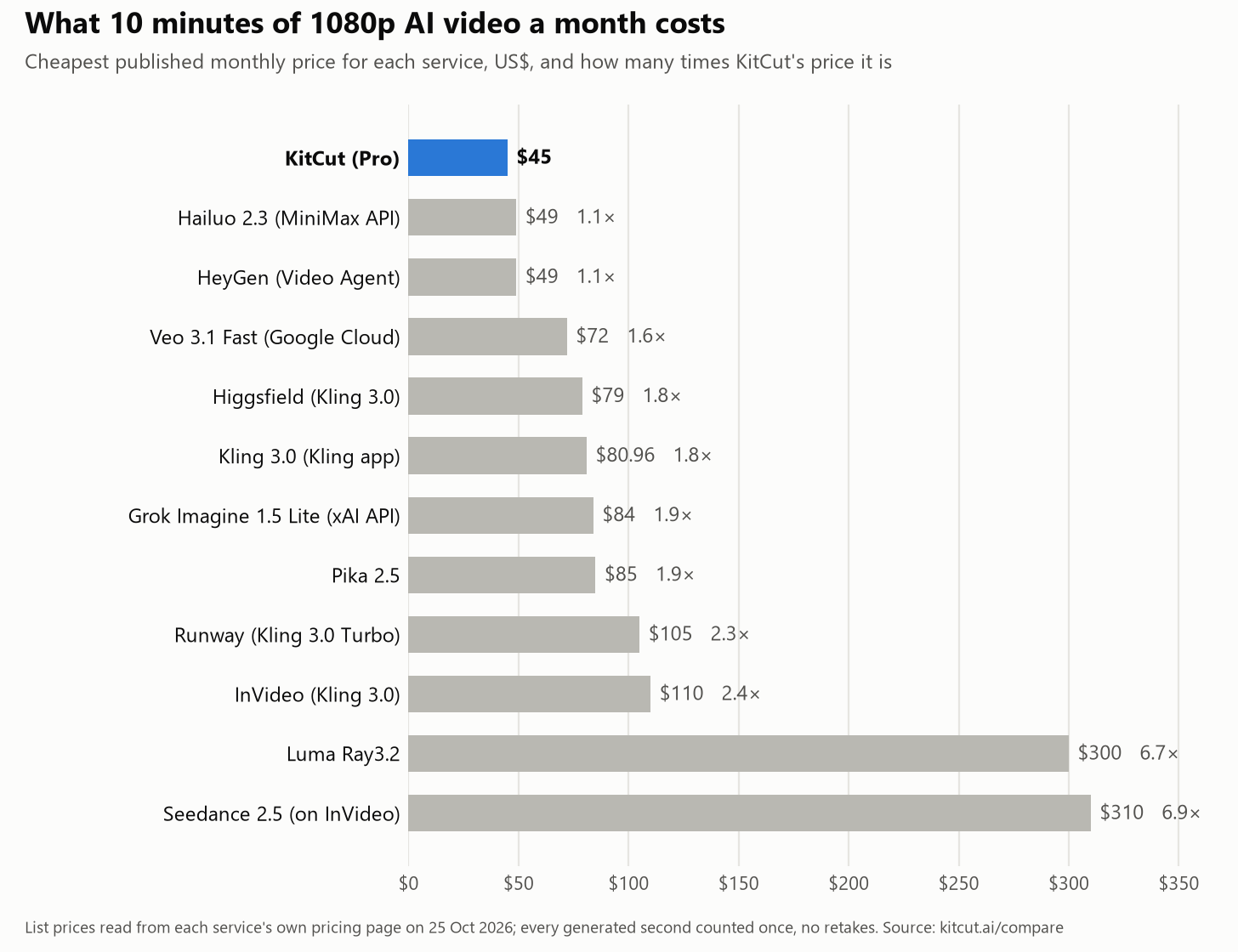
KitCut sells one plan, Pro, by the minute: $45 a month for 10 minutes of film, up to $849 for 240 minutes, which works out to $0.059 to $0.075 per second. One credit is one second of finished film, and a film that fails gets its credits back. There is a 7-day trial with 2 minutes of film, and a Free plan with 30 seconds of film to start.
Against the best-known names, for the same 10 minutes a month:
Seedance 2.5 (ByteDance's model, bought through InVideo's plans): $310, 6.9 times KitCut's price, and 7 to 8 times at every larger amount.
Higgsfield (its cheapest 1080p route, Kling 3.0 with sound): $79, 1.8 times, rising to 2.2 times at 240 minutes.
Kling 3.0 on Kling's own app: $80.96, 1.8 times.
Runway: $105, 2.3 times.
Luma Dream Machine (Ray3.2): $300, 6.7 times, and no published price buys more than 20 minutes a month.
Pika 2.5: $85; Grok Imagine (xAI API): $84; InVideo: $110.
Hailuo 2.3 (MiniMax API) and HeyGen: $49 each, the closest competitors at the entry level.
To be fair to the field: Google's Veo 3.1 Fast gets cheaper at volume. Google's AI Ultra plans buy 40 to 240 minutes of Veo clips for $99.99 to $199.99 a month, below KitCut's $159 to $849. At 240 minutes KitCut is the second-cheapest of the services that publish a price for that much.
And the comparison flatters the generators. Their price buys raw seconds of generated footage, counted as if every take were usable: no retakes, no failed generations, no script, no narration, no music and no edit. KitCut's price buys finished films, written, voiced, scored and subtitled. A 3-minute explainer from a clip generator means generating, rejecting and stitching dozens of 5- to 10-second clips, then writing and recording a voice-over and editing it all together. On KitCut it is one sentence and one price, known before the film starts.
The technology: video written as code
A KitCut film is not generated as pixels. Claude Opus 5.5, Anthropic's top model, writes the film as a program: every drawing, camera move, word on screen and music cue is code, timed to the narration. KitCut then renders that program into a 1080p video. Around it sits everything a film needs:
A director's pass first, choosing the style, the voice and the music, then a script, then the animation.
Narration by one of 30 voices, or the customer's own ElevenLabs voice, with every word timed so that the picture can change on a spoken word.
An original score on sampled instruments, with sound effects synthesised for the film and the music held under the voice.
Three looks: hand-drawn line animation, scenes painted by an image model and animated by Claude, and paper collage that moves like stop-motion.
Self-review: Claude renders stills and a motion check of its own work and fixes what it sees before the final render.
Where it is strong
Because the film is code rather than generated pixels, KitCut does well exactly where AI video generators struggle:
Words on screen are spelled right. Text is typed and set in a font, not imagined by a model.
Real data stays real. Charts are drawn from the actual numbers with their sources named, maps come from OpenStreetMap, and posts and web pages appear as they really are.
Your logo and product stay yours. An attached picture is placed as it is, never re-imagined.
Characters stay the same across scenes and across films, because a character is code that is kept and reused. That is what makes a series possible.
Long-form works. Up to 8 minutes, planned and written as one piece rather than clips stitched together.
Changes are cheap. Leave a note on a moment or a line, and the next version keeps everything else.
Brands are followed. A project reads a company's brand files (colours, typefaces, logos, tone) and every episode follows them.
Where it is limited
KitCut is clear about what it does not do:
No photorealism. There is no generated footage, no live-action look and no realistic people moving. Real people appear as drawn characters made from their photos, never as deepfakes.
No camera footage. Pictures can be added (up to 9), but uploaded video cannot.
8 minutes at most, and only on Pro (Free films go to 1 minute).
Instrumental music only: no songs or sung vocals.
16:9 from the website. Vertical and square films come from templates made in those frames, or from an AI assistant.
Minutes, not seconds. A film usually takes 8 to 30 minutes to make, longer for the longest ones.
What companies use it for
The use case that best fits the technology is the explainer a company needs again and again, and the clearest of those is employee onboarding and training:
Onboarding courses. A new hire's first week as a short series: who does what, how the product works, how to use each internal tool, built from real screenshots of the real systems, with pans, zooms and a cursor showing where to click.
Policy and compliance refreshers. The security policy, the expense process or the safety rules as a 2-minute film rather than a 20-page PDF, re-made in minutes when the policy changes.
The same course in every language. The narrator speaks the language the idea is written in, so a training series for an international team is the same brief written again.
A recurring guide. A character who comes back in every lesson makes a training series feel like a course rather than a stack of slides.
Onboarding is far from the only fit:
Product how-tos and help-center films. Instafill, a document-automation company, made 10 help-center films in two days, each 45 to 65 seconds and built from its app's real screens.
Release notes and feature launches, one film per release.
Sales enablement and customer education: a film for each objection, each feature, each industry.
Investor and board updates with charts drawn from the real numbers.
Event promotion, from conference speaker spotlights to birthday invitations, through ready-made templates.
Real estate: an open house shown on the real street map, with the real street names.
Lessons and courses for teachers and course creators.
Research and news explainers, where every number needs a source.
That last category is where KitCut's own research channel proves the point. This 3-minute investigation into the Yandex data centers, made entirely on KitCut, has passed 16,600 views, with 125 likes and 68 comments:
Faceless YouTube channels: a video a day with little effort
Faceless YouTube is one of the biggest creator niches: channels where nobody appears on camera, built on explainers, history, finance, science, sports and stories. Its bottleneck has always been production. A channel that wants a video a day needs a scriptwriter, an animator, a voice and an editor, every day.
KitCut removes that bottleneck. A channel becomes a project with a brief written once (the format, the look, the narrator, the recurring characters), and each episode is one line. KitCut makes the film, writes its YouTube title and description, draws four thumbnail options, and publishes or schedules it to the channel. One account can run several channels, each with its own niche, voice and schedule.
The proof is in channels made entirely with KitCut. Padel Tactics, a sports channel that explains padel strategy on a painted court, has reached about 1,800 subscribers and 18,500 views across 24 videos in its first weeks. Its breakout film has passed 9,200 views:
The economics are what make it work. A 1-minute video every day is about 30 minutes of film a month, which Pro's 40-minute tier covers for $159. A 3-minute video every day, about 90 minutes, fits the 120-minute tier at $439. Neither pays a writer, an animator, a voice actor or an editor.
An MCP server: let your AI agent run the channel
The most interesting way to use KitCut may not be its website at all. KitCut is an MCP server at kitcut.ai/mcp, so AI assistants and agents can use it directly: Claude (including Claude Code), ChatGPT, Grok, Meta AI and any other agent that speaks the Model Context Protocol.
That splits the work in a natural way. The AI agent does what it is good at: brainstorming, researching, reading what is trending, checking which search terms already bring viewers to the channel, and planning the next videos. KitCut does what the agent cannot: turning each plan into a finished, narrated, scored film. Through the same connection the agent can:
start films and line up several, which start one after another by themselves;
run projects, with their briefs, pictures, characters and kept voice lines;
write each film's YouTube title, description and thumbnails, and publish or schedule it on one channel or several;
read YouTube's own numbers, including the search terms that brought viewers, to decide what to make next.
In practice, a creator can tell their agent: "Research five questions people ask about index funds that nobody answers well on YouTube, make a 3-minute explainer for each, and schedule one a day on my channel." The agent researches, KitCut makes the films, and the channel fills itself. A daily channel becomes a few minutes of review a day.
KitCut Studios: made-for-you films
Alongside the self-service film maker, the company runs KitCut Studios, a professional-services division under the KitCut umbrella. Where the film maker is for people who want to make films themselves, KitCut Studios makes hyper-personalised films and series for clients: a family's own cartoon show, a pet's own series, or a company's branded series.
The service is built on the same technology, with a team writing, directing and checking every episode. Clients send photos and the true things the people (or animals) in the show say and do; KitCut Studios draws the characters from the photos, shows them to the family for approval, and writes every episode from real life. Characters are drawings, recognisably them, never photographs or deepfakes. Episodes arrive in days rather than weeks, and can go to a YouTube channel of the family's own.
Two shows on one family's YouTube channel, Leo The Big Boy, show what that looks like.
A show about your kids
Leo is a series about a real four-year-old: his walks to daycare, his first big-boy haircut, a car wash with a "wind dragon", his first airplane trip. Sixteen episodes are on YouTube so far, from under 2 to 7 minutes long and each built from things that really happened, the way he really says them. For a family, it is a keepsake their child watches on repeat; for grandparents far away, it is the next episode of their grandson's life.
A show about your pet
Duchess is a deadpan cartoon about a very dignified white cat who keeps losing her dignity: a red laser dot, a cardboard box, a spoon of sour cream, the 3 a.m. zoomies. Nine two-minute episodes so far, with a Halloween special premiering on October 31, with the same cat, the same room, the same narrator and the same running jokes in every one. It is exactly the kind of series a pet owner can commission about their own cat or dog.
Families can start at kitcut.ai/made-for-you/kids or kitcut.ai/made-for-you/pets. The case study tells how the two shows are made.
Why KitCut is one to watch
KitCut's first month shows a pattern we look for in high-growth companies: a technical difference that turns into a product people visibly love, priced so that trying it is easy.
The technology is a real wedge. Writing films as code solves the problems generators keep running into (wrong words, invented charts, drifting characters, short clips), and that is exactly what explainers, training and series need.
The price is a growth engine. Finished, narrated films for less than most competitors charge for raw footage make the decision easy for creators and companies alike.
Agents are a new distribution channel. As more work moves into Claude, ChatGPT and other agents, a video tool that agents can call directly is in the path of that shift.
Services add a premium tier. KitCut Studios turns the same technology into thousands of dollars per client, for the families and companies who would rather have it made for them.
Its own homepage tells the rest of the story: hundreds of films, made by people a month ago had never heard of it. You can browse them, or make one, at kitcut.ai.