
The inside story of a former Snap exec who built Kazakhstan’s first unicorn and the fastest-scaling AI video platform—turning $0 into $200M ARR in nine months with cinematic precision, social-first distribution, and a bet on marketing automation.
TL;DR
Higgsfield’s success is the result of elite founder pedigree meeting perfect market timing. Alex Mashrabov—who sold his previous startup AI Factory to Snap for $166M and led generative AI there—launched Higgsfield in March 2025 just as social video demand exploded and AI models reached production quality. The team paired a multi-model aggregator platform (integrating Sora 2, Veo 3, Kling, and proprietary models) with marketing automation tools like Click-to-Ad, creating a system where brands turn product URLs into campaign-ready videos in minutes.
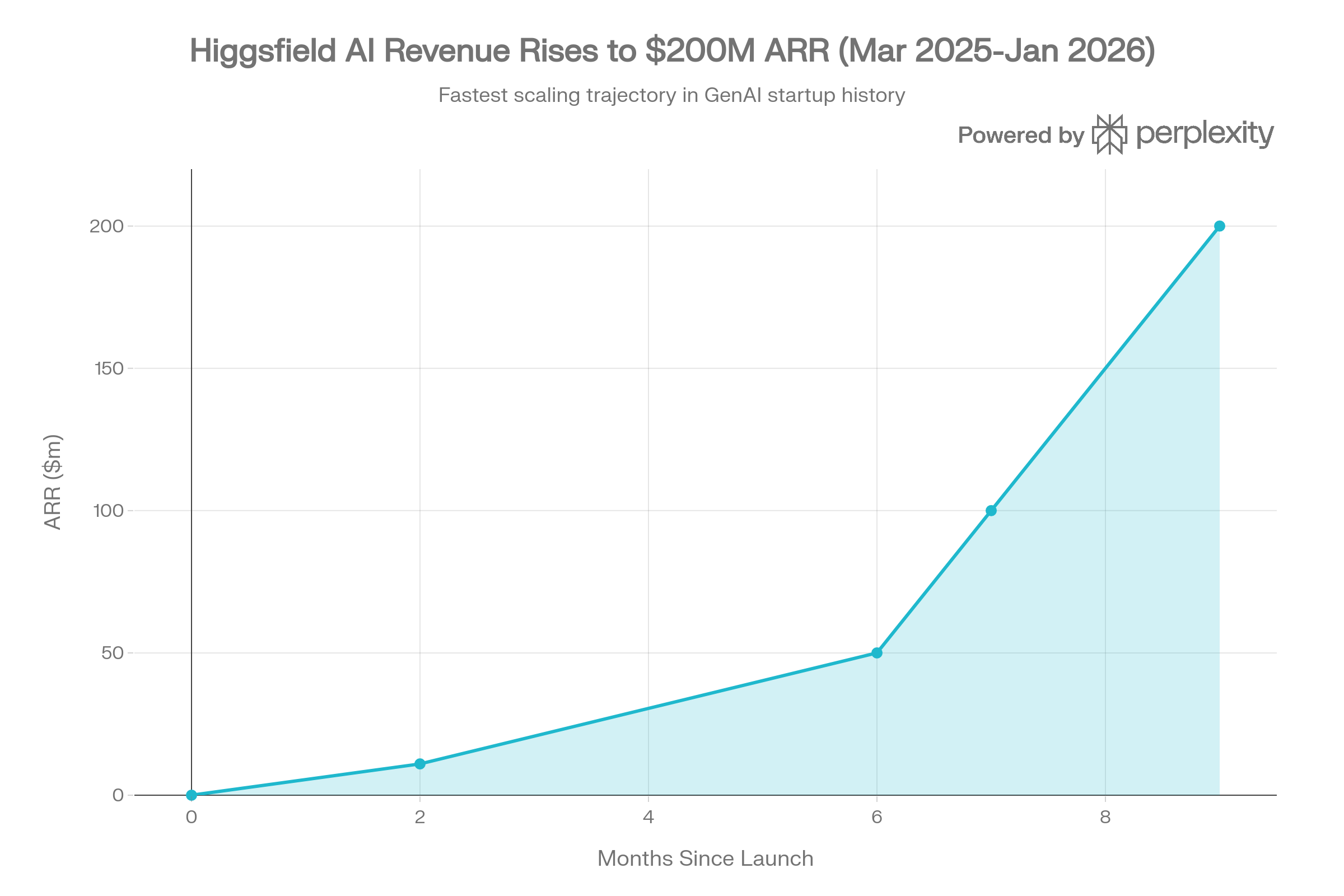
As of January 2026, Higgsfield claims 15M+ users, 4.5M daily video generations, $200M ARR (up from $0 nine months prior), and a $1.3B valuation following an $80M Series A extension. Pricing starts at $9/month for 150 credits, undercutting competitors while offering access to cutting-edge models and 200+ trending presets. The company is Kazakhstan’s first tech unicorn and claims the fastest revenue growth of any GenAI startup—outpacing early OpenAI, Slack, and Zoom trajectories.
What Actually Happened (The Timeline & Inflection Points)
Higgsfield AI achieved a $200M annual run rate in just 9 months, doubling from $100M in approximately 2 months—a growth velocity that outpaced early-stage trajectories of OpenAI, Slack, and Zoom
2023: Stealth mode + technical foundation
Founded by Alex Mashrabov (ex-Snap Head of GenAI, sold AI Factory for $166M) and Yerzat Dulat (AI researcher specializing in generative video), Higgsfield spent over a year in stealth building its core video reasoning engine and model infrastructure. The founding team brought deep expertise from Snap’s AR/GenAI products (MyAI chatbot, Cameos, filters) and a track record of scaling consumer AI to hundreds of millions of users.
Early 2024: Mobile experiments + mobile-first DNA
Higgsfield initially launched mobile apps, including Diffuse—a personalized storytelling app that hit #1 in Graphics on the App Store. The mobile experiments validated consumer appetite for AI video but revealed app store economics (30% fees) made scaling difficult. Critical insight: creators needed professional-grade tools on desktop, not just mobile toys.
March 2025: Browser platform launch—the real beginning
Higgsfield pivoted to a browser-based platform with cross-model access and launched publicly. This was the inflection point. Within two months (by May 2025), the company hit $11M ARR, 20,000+ paying users, and 2M+ monthly active users—with zero ad spend. The growth was purely organic, fueled by social media virality (creators sharing outputs) and word-of-mouth among marketers.
May-September 2025: Seed → Series A + unicorn status
$8M seed (April 2024) led by Menlo Ventures
$50M Series A (September 2025) led by GFT Ventures at >$1B valuation
By six months post-launch, ARR reached $50M
September 2025: Officially became Kazakhstan’s first unicorn
October-December 2025: Hypergrowth acceleration
Revenue doubled from $100M to $200M ARR in ~8 weeks. What changed? Two things:
OpenAI partnership: Integration of GPT-4.1, GPT-5, and Sora 2 gave Higgsfield exclusive access to the most hyped video model, with a “reasoning layer” that translates creative intent into structured video plans before generation
Marketing automation: Launch of Click-to-Ad (URL → video ad in minutes) and 200+ trending presets turned Higgsfield from a creative tool into production infrastructure for brands running thousands of ad variants
By December 2025, 85% of usage came from social media marketers, and 80% of that segment was delivering commercial work—not casual experimentation.
January 2026: $80M extension + $1.3B valuation
Higgsfield announced an $80M Series A extension (total Series A: $130M+) from Accel, AI Capital Partners (Alpha Intelligence Capital), and Menlo Ventures at a $1.3B+ valuation. The round was fueled by:
$200M ARR achieved in 9 months
15M+ users and 4.5M daily video generations
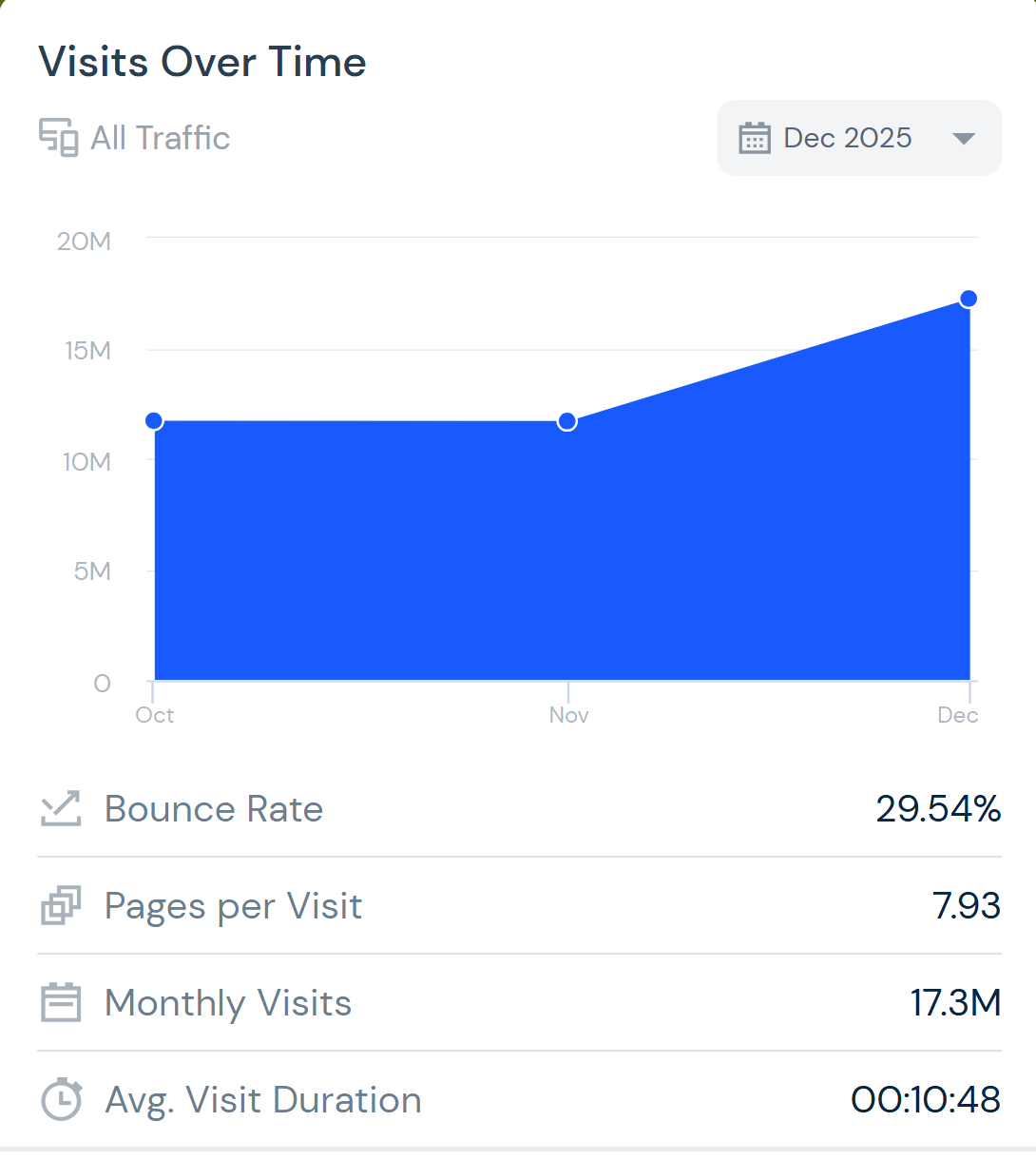
22.26M monthly web visits (+47% MoM growth in Dec 2025)
Claims of being the fastest-scaling GenAI startup ever
Higgsfield AI achieved a $200M annual run rate in just 9 months, doubling from $100M in approximately 2 months—a growth velocity that outpaced early-stage trajectories of OpenAI, Slack, and Zoom
The Growth Engine (Why It Worked)
1. Elite founder + team arbitrage
Mashrabov’s pedigree opened doors. A two-time ICPC World Finalist and Forbes 30 Under 30 honoree who’d already sold a company to Snap for $166M, he had credibility with top-tier VCs and engineers. The team recruited heavily from competitive programming circuits (the MIT/ICPC “mafia”) and Snap’s GenAI org—talent pools that produce OpenAI and Cognition Labs alumni.
Critical arbitrage: 63 engineers work from Astana, Kazakhstan; only 7 in San Francisco. This gave Higgsfield Silicon Valley-quality engineering at emerging-market cost structures while maintaining access to U.S. capital and customers.
2. Model-agnostic platform (the “open router” strategy)
While competitors like Runway build proprietary models, Higgsfield became the “open router” for AI video—integrating Sora 2, Google Veo 3.1, Kling 2.6, Nano Banana Pro, WAN 2.5, and proprietary models like Higgsfield DOP into one dashboard. This strategy:
De-risks model obsolescence: If OpenAI’s Sora dominates, Higgsfield wins. If Google Veo wins, Higgsfield wins.
Maximizes feature velocity: New models plug in weekly; Higgsfield shipped 200+ product releases in 2025 alone
Lowers switching costs for users: Marketers don’t need to learn five tools—they run experiments across models in one workspace
The cinematic reasoning layer—powered by GPT-4.1/GPT-5—acts as a “director” that interprets user intent, applies motion logic, and maps inputs to the optimal model for the job. This abstraction turns raw AI into usable creative infrastructure.
3. Marketing automation as the killer app
Higgsfield didn’t win by making “better videos”—it won by making better workflows. The platform enables:
Click-to-Ad: Paste a product URL → Higgsfield scrapes images, brand colors, logo, product description → generates 10 ad variants (each with different pacing, style, camera motion) in minutes
UGC Factory: Upload your photo + script → AI generates influencer-style product videos with realistic lip-syncing and branded environments
Sora 2 Trends: 200+ viral video presets (updated daily) that apply platform-specific pacing and motion to match TikTok/Reels/Shorts algorithms
The business model shift: Brands moved from “testing AI video” to running their entire creative pipeline on Higgsfield—producing 10,000+ ad creatives/year and spending $200K+ annually on the platform. This isn’t a tool; it’s production infrastructure.
4. Social-first distribution + 3B impressions
Higgsfield accumulated 3 billion social media impressions by December 2025—not through ads, but by making every output shareable. When a creator generates a cinematic AI video and posts it to TikTok, the output itself becomes a billboard for Higgsfield. High-quality, trend-aligned videos naturally go viral, driving “what tool did you use?” comments and creator signups.
Organic keyword dominance: Higgsfield ranks #1 for “higgsfield ai” (40.5K monthly searches) and top 5 for “sora 2” (246K searches). The SEO moat grows as more creators publish tutorials and showcases.
5. Pricing arbitrage vs. value delivered
Public pricing undercuts incumbents:
Basic $9/month (150 credits) vs. Runway Standard $12/month (625 credits)
Pro $17-29/month (500-600 credits) vs. Runway Pro $28/month (2,250 credits)
Ultimate $24-49/month (1,200 credits + unlimited on select models) vs. Runway Unlimited $76-95/month
But the value gap is wider than pricing. Higgsfield offers access to Sora 2, Veo 3.1, and Kling at these prices, while Runway’s credits only work on Runway models. For marketers testing variants, the ability to run 5 concepts across 3 models (15 outputs) in one session beats buying credits on three separate platforms.
6. Speed as a competitive moat
Stripe reported Higgsfield grew from $0 to $200M run rate in processed payments in 9 months—a pace Stripe had “never witnessed” even among hypergrowth SaaS companies. The company attributes this to:
Daily product releases: Higgsfield ships features continuously; competitors ship quarterly
Real-time feedback loops: 86% M1 revenue retention (early data) suggests product-market fit, allowing rapid iteration based on paying-user behavior
95.6% payment authorization rate (via Stripe optimizations), meaning fewer failed transactions and higher conversion
The Role of Timing
Pandemic aftermath (2020-2024): Infrastructure buildout
While competitors like Runway launched early (2018) and rode the initial AI hype, Higgsfield waited. The 2020-2023 period saw:
Remote-first workflows normalize video-heavy communication
Short-form video explosion: TikTok, Reels, Shorts became primary content formats; U.S. users now spend 61% of social media time watching videos (up from 33% in 2019)
Creator economy professionalization: Solo creators and small agencies became businesses needing scalable production tools
Mashrabov spent this time at Snap, building MyAI and AR effects for hundreds of millions of users—learning what works at consumer scale.
2023-2025: GenAI model step-change
GPT-4 (March 2023) validated transformer architectures for multimodal tasks. Midjourney V5 (2023) showed consumers would pay for AI creativity. But video lagged—until Sora 1 (Feb 2024) and Runway Gen-3 (2024) reached “good enough” quality for professional use.
Higgsfield launched March 2025—exactly when:
Sora 2 entered limited partnerships (OpenAI needed distribution)
Google Veo 3 added native audio synthesis
Social platforms’ native AI features (Instagram AI, TikTok effects) validated consumer demand but remained simplistic—creating an opening for professional-grade tools
The wedge: Platforms like Zoom and Microsoft added AI summaries, but they increased demand for third-party creative tools—just as Fireflies.ai rode the meeting-bot wave by offering cross-platform aggregation and workflows beyond transcription.
2025-2026: Marketing budget shift
U.S. mobile social video ad spend hit $60.94B in 2025. Brands need thousands of ad variants for A/B testing across TikTok/Meta/YouTube, but traditional production (agencies, influencers) costs $150-500 per video. Higgsfield’s $1-10/video economics (depending on subscription tier) unlocked a 10-100x cost arbitrage, making “test 50 concepts weekly” feasible for mid-market brands.
Nielsen data showed AI-powered video campaigns deliver 17% higher ROAS than manual campaigns—giving CFOs permission to reallocate budgets from traditional production to AI tools.
Numbers Snapshot (As of Mid-January 2026)
Higgsfield AI differentiates through its model-agnostic platform and marketing automation capabilities, achieving unprecedented growth velocity in the AI video generation market
Users & scale:
15M+ users across 500K+ organizations (estimated from growth trajectory)
4.5M videos generated daily
3 billion social media impressions (cumulative)
22.26M monthly web visits (+47% MoM in Dec 2025)
17:32 average session duration, 8.45 pages/visit, 36% bounce rate
Revenue & valuation:
$200M ARR (achieved in 9 months from launch)
$1.3B+ valuation (Jan 2026)
$130M+ total funding ($50M initial Series A + $80M extension)
Several customers spending $200K+/year on beta marketing automation
Traffic & distribution:
75% of revenue from outside U.S.
706K organic search visits/month (+66% MoM)
Top keyword: “higgsfield ai” (40.5K volume), ranks #1
Also ranks #5 for “sora 2” (246K searches)
Team & operations:
~70 employees (Jan 2026), scaling to ~300 by end of year
63 in Kazakhstan, 7 in U.S.
200+ product releases in 2025
Pricing (annual billing):
Free: 5-10 credits/day, watermarked
Basic $9/month: 150 credits
Pro $17-29/month: 500-600 credits
Ultimate $24-49/month: 1,200 credits + unlimited on premium models
Creator $49/month: 6,000 credits + 2-year unlimited access
Payment infrastructure (Stripe):
95.6% authorization rate (vs. industry avg ~85%)
3-day integration with one backend engineer
Supports stablecoins and local currency pricing in 75+ countries
Higgsfield AI differentiates through its model-agnostic platform and marketing automation capabilities, achieving unprecedented growth velocity in the AI video generation market
How Higgsfield Compares (Competitive Landscape)
vs. Runway (cinematic quality leader)
Runway (founded 2018) is the incumbent, backed by top VCs and Hollywood studios (Lionsgate partnership). Gen-4/Gen-4 Turbo deliver superior motion physics and 4K upscaling.
Where Runway wins:
Cinematic realism and physics (fabric drape, liquid motion)
Professional integrations (Premiere, After Effects)
4K export and collaborative workspaces
Where Higgsfield wins:
Model diversity: Access to Sora 2, Veo 3, Kling, vs. Runway-only models
Cost: $9-49/month vs. $12-95/month; Higgsfield’s unlimited tiers include multiple premium models
Marketing automation: Click-to-Ad, URL-to-video, bulk generation workflows
Speed: Avg 3-5 min/video vs. Runway’s 8-12 min for complex scenes
Verdict: Runway for Hollywood-grade filmmaking; Higgsfield for high-throughput social marketing.
vs. Synthesia (avatar training video leader)
Synthesia focuses on corporate training and explainer videos with hyper-realistic avatars. Pricing: $30-90/month for 10-30 minutes of AI-generated talking-head video.
Where Synthesia wins:
Avatar consistency and realism
Enterprise compliance (GDPR, SOC 2, HIPAA on Enterprise tier)
Predictable per-minute pricing ($0.75-3/min)
Where Higgsfield wins:
Creative flexibility: Cinematic camera motion, VFX, product-centric workflows vs. static talking heads
Social-first: Optimized for TikTok/Reels vs. corporate LMS
Lower entry price: $9/month vs. $30/month
Verdict: Synthesia for L&D/corporate training; Higgsfield for performance marketing and UGC.
vs. Native platform tools (Zoom, CapCut, Canva)
Platform risk: TikTok, Meta, and YouTube are all building native AI video editors. CapCut (owned by ByteDance) offers free AI tools to 200M+ users.
Why Higgsfield survives platformization:
Cross-platform: Works across TikTok, Instagram, YouTube vs. platform-locked tools
Depth: 200+ trending presets, multi-model access, and automation APIs vs. simplistic one-click filters
Enterprise workflows: Bulk generation, team collaboration, brand consistency tools that platforms don’t prioritize
The Fireflies parallel: Just as Fireflies.ai survived Zoom AI Companion by offering cross-platform meeting notes + CRM integrations, Higgsfield’s moat is aggregation + workflow automation, not raw video quality.
Why Higgsfield Got Traction While Others Stalle
d
1. Distribution through outputs
Every video generated becomes a distribution channel. High-quality, trend-aligned clips posted to TikTok/Reels drive “How did you make this?” engagement, funneling creators to Higgsfield organically. 3 billion impressions with zero ad spend proves the flywheel works.
2. Founder-led sales to enterprises
Mashrabov’s Snap pedigree opened doors at Fortune 500 marketing orgs. The pitch: “We’re the team that built Snap’s AI—now we’re building your creative infrastructure.” By October 2025, several customers were spending $200K+/year—a signal that Higgsfield wasn’t just a creator toy but enterprise-grade infrastructure.
3. Solve pain, not technology
Competitors talk about “training our own models” or “proprietary architectures.” Higgsfield talks about “turn your product page into 50 ad variants in 10 minutes.” The value prop is outcome-focused, not tech-forward. DTC brands don’t care which model runs under the hood—they care about CAC payback periods.
4. Speed compounds
Shipping 200 product releases in a year means Higgsfield iterates 3-4x faster than quarterly-shipping competitors. This creates a perception of momentum (”they’re always launching something new”) that drives press coverage, creator buzz, and VC interest—self-reinforcing loops that slower competitors can’t match.
5. Kazakhstan cost structure + SF capital access
Running 63 engineers in Astana while raising from Accel and Menlo Ventures in SF is the ultimate arbitrage. Higgsfield gets Valley-quality capital and distribution with emerging-market burn rates, extending runway and allowing aggressive R&D investment.
Headwinds & Risks (And How Higgsfield Is Addressing Them)
1. Platform encroachment (OpenAI, Google, Meta building video)
OpenAI’s Sora is Higgsfield’s biggest partner and existential threat. If OpenAI launches a consumer product (ChatGPT Video Studio?), it could disintermediate Higgsfield overnight.
Mitigation: Higgsfield’s moat isn’t model access—it’s the reasoning layer + marketing automation. The platform uses GPT-5 to plan videos (narrative arc, pacing, camera logic) before Sora generates pixels. Even if OpenAI offers Sora directly, marketers would need to build automation workflows—Higgsfield’s Click-to-Ad, bulk generation, and preset library become the sticky layer.
2. Commoditization of video generation
As models improve and costs drop, raw video generation becomes table stakes. Runway, Pika, Kling, and Veo will all offer “good enough” quality at similar prices.
Mitigation: Higgsfield is moving up the stack into outcomes:
URL → Ad workflows (creative strategy + execution)
A/B testing infrastructure (generate 50 variants, track performance, auto-iterate)
API for programmatic generation (brands can trigger video creation via webhooks)
These workflows require data integrations, analytics, and domain expertise that pure model providers don’t offer.
3. Quality inconsistency across models
Third-party reviews note Higgsfield’s multi-model approach creates variable output quality. Sora 2 delivers cinematic results; Kling 2.6 handles motion well but struggles with faces; proprietary models like Higgsfield DOP are hit-or-miss.
Mitigation: The platform’s preset system encodes “known good” parameters for each model, reducing failure rates. Over time, the reasoning layer learns which model handles which type of shot (e.g., “use Veo 3 for audio-synced product demos, Sora 2 for cinematic b-roll”). Machine learning on user feedback (like/dislike, re-generate patterns) will auto-route prompts to optimal models.
4. Revenue concentration in top customers
If several customers each spend $200K+/year, losing one or two could materially impact ARR. Enterprise churn is catastrophic at this scale.
Mitigation: Land-and-expand through freemium. Higgsfield’s free tier (5-10 credits/day) drives bottoms-up adoption within enterprises, creating “shadow IT” usage that IT/marketing eventually consolidates under paid contracts. This reduces dependency on top-down enterprise sales cycles.
5. Regulatory and IP risks
Generative AI faces growing scrutiny over copyright (training data sources), deepfakes, and misuse. Higgsfield’s UGC Factory (AI avatars) and Face Swap tools could enable harmful content.
Mitigation: SOC 2 compliance and trust centers (similar to Fireflies) reduce enterprise buyer anxiety. Higgsfield also relies on OpenAI/Google’s hosted models, offloading some liability to foundation model providers who’ve negotiated indemnification deals (e.g., OpenAI’s copyright shield).
Bottom Line (My Read)
Success drivers: Higgsfield nailed the trifecta of elite team (Snap pedigree + competitive programming talent pool), market timing (launched March 2025 when Sora 2 + Veo 3 reached production quality and social video ad budgets peaked), and strategic positioning (model-agnostic aggregator + marketing automation vs. single-model tools). The $200M ARR in 9 months isn’t just hype—it reflects real commercial adoption by brands running production workflows, not pilot projects.
Competitive posture: Higgsfield is strong vs. pure creative tools (Runway, Pika) because it solves workflow pain, not just generation quality. It’s vulnerable to OpenAI if Sora becomes a standalone product with built-in automation, but the reasoning layer and integrations (Stripe billing, CRM syncs, analytics) create switching costs. The Kazakhstan cost structure gives Higgsfield a burn-rate advantage that extends runway and funds aggressive R&D—critical in a space where model capabilities double every 6-12 months.
Sustainability questions: Can Higgsfield maintain 200+ releases/year as headcount scales from 70 to 300? Can it avoid enterprise customer concentration risk? Can it defend gross margins if OpenAI/Google cut API pricing by 50%? The next 12 months will test whether Higgsfield’s velocity is a feature or a bug.
For now, the data says: This isn’t vaporware. 4.5M daily video generations, $200M ARR, 15M users, and $130M from top-tier VCs suggest Higgsfield has built something real. Whether it becomes the “Stripe of AI video” or gets disintermediated by platforms is the $1.3B question.
Sources & Key
Company milestones, valuation, ARR: Reuters, TechCrunch, PR Newswire (Jan 15, 2026 funding announcement). Revenue growth timeline: Stripe case study, Sacra estimates, LinkedIn posts (9-month $0→$200M trajectory). User metrics: Company announcements (15M users, 4.5M daily videos). Traffic data: Semrush, Similarweb (22.26M monthly visits, Dec 2025). Founder background: MIT News, LinkedIn (Mashrabov), YouTube interviews. OpenAI partnership: OpenAI case study (Sora 2 + GPT-4.1/GPT-5 integration). Pricing: Official Higgsfield pricing pages, third-party reviews. Kazakhstan connection: Astana Times, Kursiv (first unicorn announcement). Market size: Fortune Business Insights, Grand View Research (AI video market $534M→$2.5B by 2032). Competitor data: Runway pricing, Synthesia pricing, comparison analyses. Marketing automation: Higgsfield blog posts on Click-to-Ad, Ads 2.0 features. Social media ad spend: eMarketer, IAB reports ($60.94B U.S. mobile social video ads, 2025).