

Ask Claude or ChatGPT to fill out a PDF form and it will usually read the form well and tell you what to write in each box. Then it hands the typing back to you. Reading a form is a language problem. Writing into it is a file problem: field names that mean nothing (”Text17”), checkboxes with hidden export values, XFA forms that most PDF viewers can’t even open, and a finished file that has to open correctly at an insurance company or a county court.
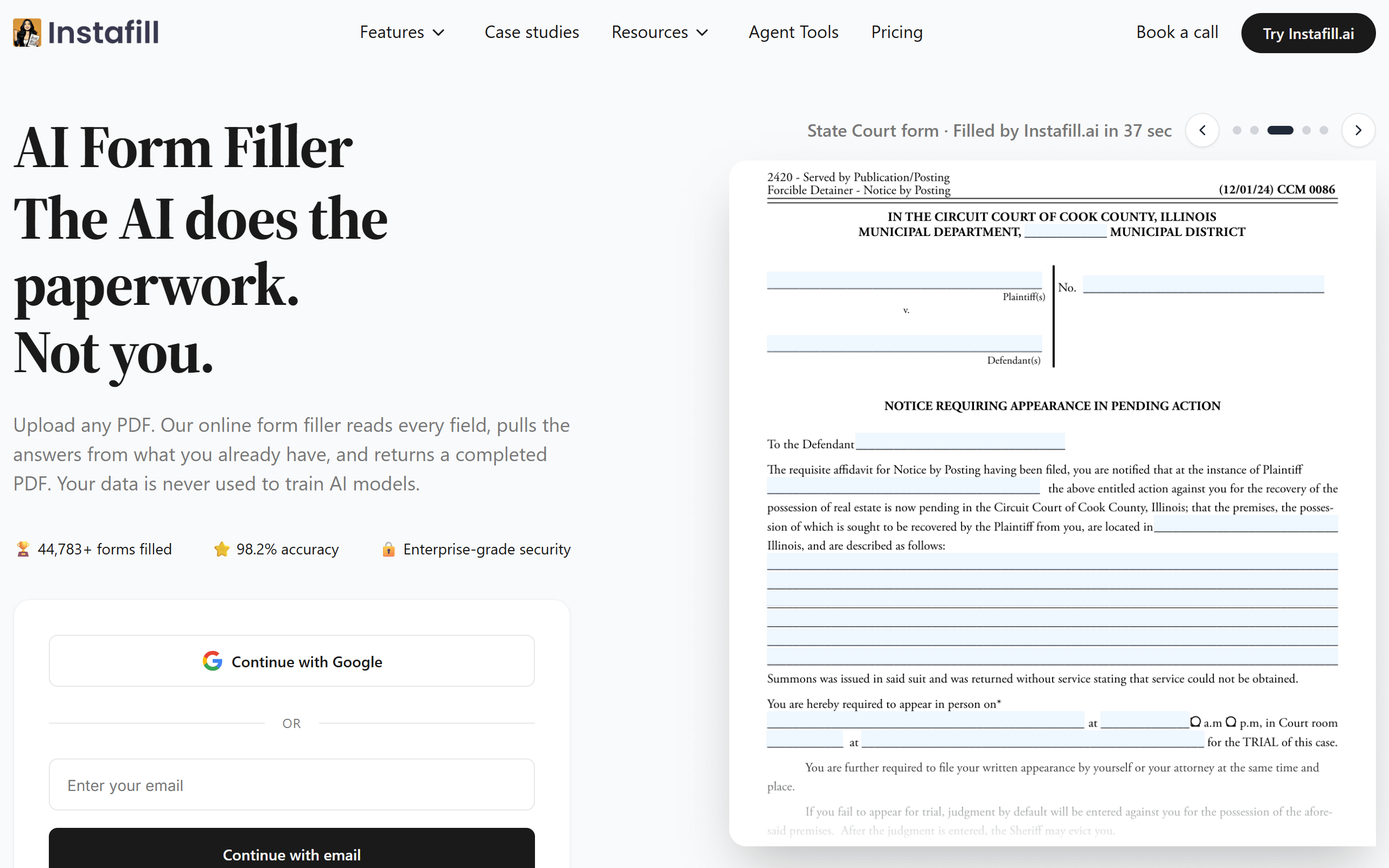
That gap is what an AI form-filling agent closes. The assistant does the talking; a form engine behind it does the writing. Instafill.ai is one of those engines, and its numbers say something about where this market is going.
People don’t search for “AI form filler”. They search for the form.
In the last 90 days Instafill.ai got 39,992 clicks from Google. Only about 5,000 of them landed on the home page, the page that ranks first or second for “ai form filler”. Most of the rest went to a page for one specific form: the ACORD 36 broker-of-record change, the ADP direct deposit form, a standard employment application, a California social services statement.
That is the pattern of the whole category. Nobody wakes up wanting an AI form filler. They wake up with a form due today.
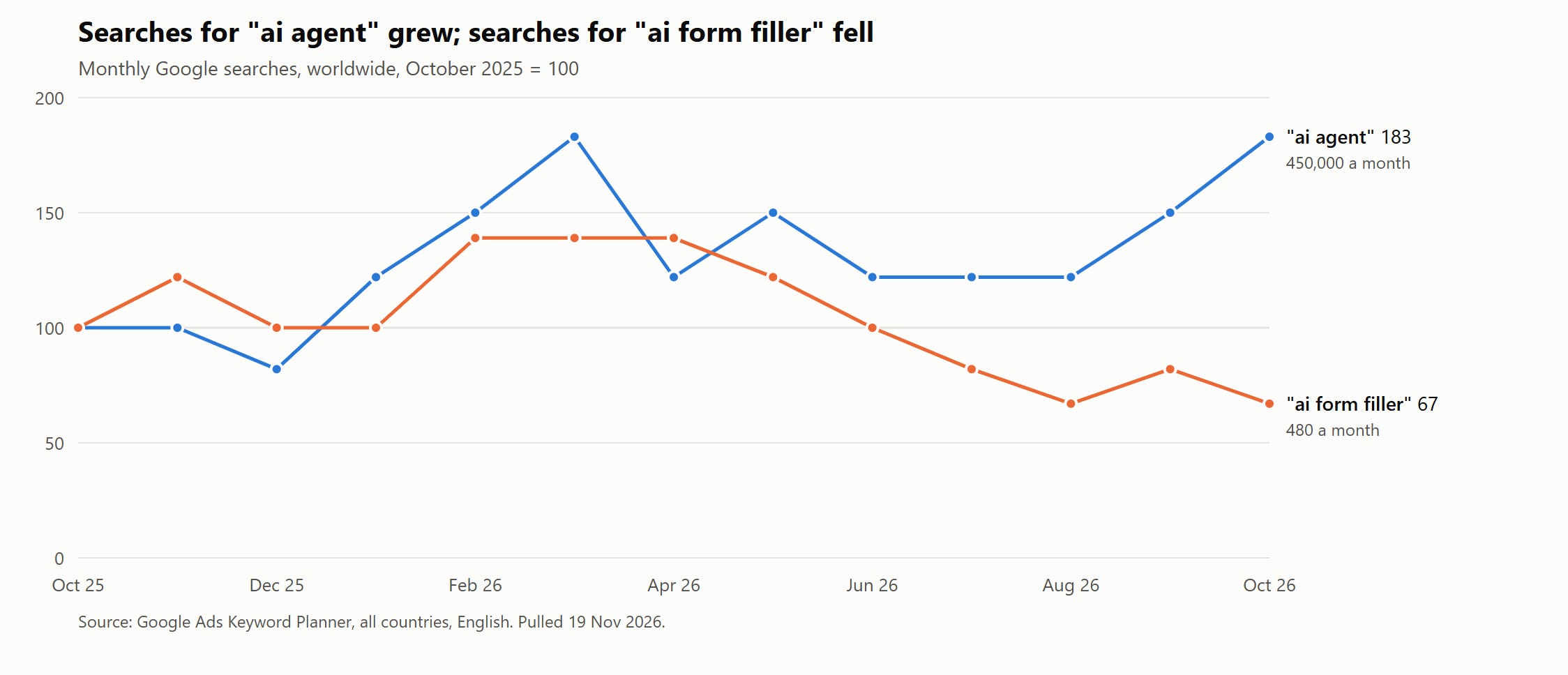
The search data points the same way. Worldwide, “ai form filler” peaked at about 1,000 searches a month in early 2026 and fell to 480 in October. Over the same year “ai agent” went from 246,000 to 450,000. My reading: people stopped looking for a separate tool for each chore and started expecting the assistant they already use to do the chore. Keyword numbers can’t prove that, but both lines point the same way.
What a form-filling agent actually has to do
Find the right form. The 2016 ACORD 25 and the 2010 one are not interchangeable. Instafill.ai has scored 12,437 forms on how hard they are to complete; the median scores 51 out of 100, and 23% count as complex.
Map your data to the fields. Names, addresses and policy numbers come from documents you already have: a photo of a license, last year’s filled form, an email.
Write a real PDF. Checkboxes, radio buttons, dropdowns, tables with hundreds of cells. The longest form Instafill.ai has processed ran to 204 pages.
Show its work. Every filled field needs a source a person can check before they sign.
A general assistant does the first two well enough. The last two are where it needs a tool.
Why now: the assistants can call tools
The Model Context Protocol (MCP) gave assistants a standard way to call outside tools. Instafill.ai’s MCP server gives Claude, ChatGPT and Codex 20 tools: find a form, inspect its fields, fill it from a saved profile or a past fill, check the job and download the PDF. You ask in plain words, something like “fill the W-9 for this client”, and the assistant runs the steps.
Mobile matters here too. 22% of the forms on Instafill.ai are already filled from a phone. An assistant app on a phone, with a camera and a chat box, is a natural place to say “here is the document, fill the form”.
The numbers behind it
47,537 unique forms filled, by people in 138 countries.
Under 45 seconds for the average form, whatever its length.
Healthcare is the biggest user at 31% of all forms (prior authorizations, credentialing, disability statements), followed by legal.
94,000 forms in one day at the peak, the US tax deadline on 15 April 2025.
156,000 people used its earlier ChatGPT plugin, before MCP existed.
Where it is limited
Not in ChatGPT’s directory yet. The listing is still in OpenAI’s review, which keeps sending the sign-in flow back for fixes. Today a ChatGPT user connects it by hand in developer mode, on a paid plan, which most people won’t do. Builders HQ, another of our MCP servers, saw almost all of its users arrive only after its ChatGPT listing went live.
A person still signs. The agent fills; someone has to read the result before it goes to an insurer or a court.
Generic demand is small and falling. The money is in thousands of specific forms, each searched by a few hundred people a month, not in one big keyword.
What comes next
Form filling is one of the oldest office chores and one of the clearest jobs for an AI agent: the input is messy, the output is strict, and the result can be checked field by field. The open question is distribution. The assistant directories decide who finds these tools, and a form-filling agent has to get through their review like any other app.